

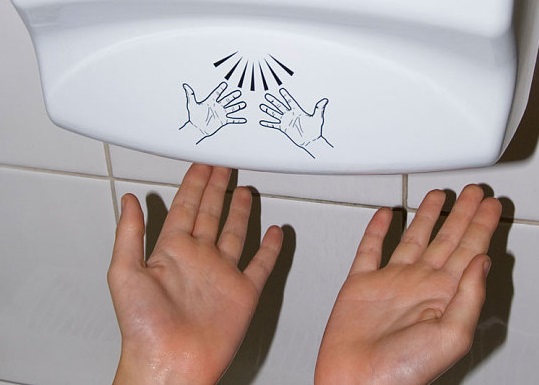
The University of Westminster's snappily-titled study 'Comparison of different hand-drying methods: the potential for airborne microbe dispersal and contamination' was published in the March 2015 edition of The Journal of Hospital Infection. The research also claims that bathroom air dryers may be blasting bacteria directly into the faces of children.
The university's study was undertaken by leading microbiologist Keith Redway of the University’s Department of Biomedical Sciences and looked at the potential for microbial contamination from hand drying and the potential risks for the spread of microbes in the air, particularly if hands are not washed properly.
Paper towels, a textile roller towel, a warm air dryer and a jet air dryer were compared using three different test models: acid indicator using lemon juice, yeast, and bacterial transmission from hands when washed without soap.
The University of Westminster scientists found that the jet air dryer spread liquid from users’ hands further and over a greater distance – up to 1.5 m – than the other drying methods. They also recorded the greatest spread of microbes into the air at both near and far distances for each of the tested models.
Levels recorded at close distance for a jet air dryer revealed an average of 59.5 colonies of yeast compared with an average of just 2.2 colonies for paper towels. At a distance of 0.2 m the jet air dryer recorded 67 colonies of yeast compared with only 6.5 for paper towels. At a distance of 1.5 m the jet air dryer recorded 11.5 colonies of yeast compared to zero for paper towels. It found the greatest dispersal was at 0.6 – 0.9 m from the floor, the face height of small children who might be standing near the dryer when a parent is drying his or her hands.
This, claims the study's authors, suggests that parents should take care to keep children away from the direct air stream of jet air dryers in washrooms to ensure that they are not unintentionally contaminating youngsters.
Leading researcher Keith Redway said: "These findings clearly indicate that single-use towels spread the fewest microbes of all hand-drying methods.